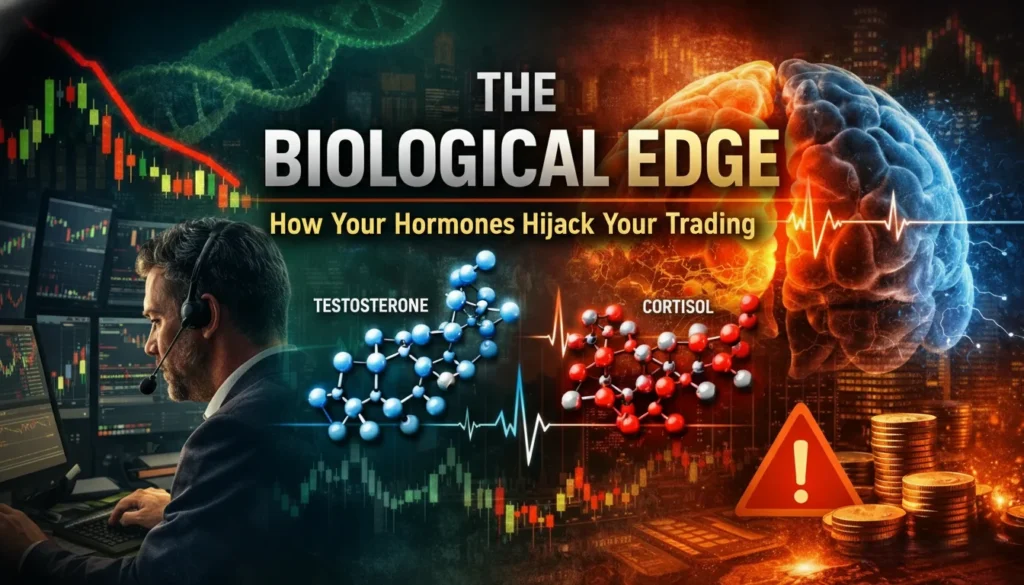
The Biological Edge : Modern trading culture assumes that success is primarily a function of strategy quality. Find the right setup, the right indicator, or the right algorithm — and profits will follow. This assumption is wrong. Trading is not only a cognitive activity. It is a biological one.
Over the last two decades, research in neuroeconomics, endocrinology, and behavioral finance has demonstrated that a trader’s internal physiological state — particularly their hormonal and neural baseline — plays a decisive role in execution quality, risk perception, and long-term survival.
This article audits the most credible findings in this field and reframes them through the Tradorion Risk-First lens: biology is not an edge to exploit, but a risk to manage.
Trading Is a Biological System, Not a Rational One
The traditional “rational actor” model assumes traders:
- Evaluate information objectively
- Respond proportionally to risk
- Adjust behavior logically
Real traders don’t behave this way — not because they are weak, but because they are human.
Every trade decision is filtered through:
- Stress hormones
- Reward anticipation
- Fear responses
- Confidence loops
Ignoring this is not professionalism. It is negligence.
1. The London Trading Floor Study: Hormones and Profitability
One of the most influential studies in this domain was conducted by John Coates and Joe Herbert (2008) on professional traders in the City of London.
Over eight trading days, researchers measured traders’ endogenous testosterone and cortisol levels and compared them with daily profitability.
The results were unsettling.
The Winner Effect: Testosterone and Overconfidence
The study found that higher morning testosterone levels predicted higher profitability later the same day.
At first glance, this sounds like a competitive advantage.
But here’s the critical nuance:
- Testosterone increases confidence and risk appetite
- Wins raise testosterone further
- This creates a positive feedback loop
This loop — known as the Winner Effect — can temporarily enhance performance, but when left unchecked it pushes traders from calculated aggression into irrational exuberance.
This is how bubbles are traded — not by fools, but by confident professionals whose biological systems overshoot reality.
Cortisol: The Hidden Cost of Uncertainty
While testosterone tracks success, cortisol tracks uncertainty.
Cortisol rises when:
- Market volatility increases
- Outcomes become unpredictable
- Control feels diminished
Chronic elevation of cortisol:
- Impairs decision-making
- Increases risk aversion
- Encourages premature exits
- Creates “freeze” responses
In extreme cases, it leads to learned helplessness — a state where traders stop acting even when opportunities are statistically favorable.
The Dual-Hormone Hypothesis: When Confidence Becomes Dangerous
Later research expanded on these findings through the Dual-Hormone Hypothesis.
The conclusion is subtle but critical:
High testosterone improves performance only when cortisol is low.
This explains why:
- Confident traders sometimes perform exceptionally well
- The same traders later implode under stress
The dangerous state is high testosterone + high cortisol:
- Aggression without clarity
- Risk-taking under strain
- Impulsive execution
This is not strength. It is biological noise.
Neural Warning Signals Before You Make a Mistake
Functional MRI studies by Brian Knutson and colleagues push this analysis even deeper.
They show that the brain often signals future mistakes before conscious awareness.
Two regions matter most:
Nucleus Accumbens (NAcc)
- Associated with reward anticipation
- Overactivation precedes risk-seeking errors
- Linked to chasing, overconfidence, and FOMO
Anterior Insula (AIns)
- Associated with discomfort and risk awareness
- Overactivation precedes excessive caution
- Linked to premature exits and hesitation
Professional traders are not immune to these signals — they are simply better at not obeying them.
Biology Is Not Destiny (And This Matters)
Some studies link prenatal androgen exposure (measured via the 2D:4D finger ratio) to trading longevity.
This is interesting — but dangerous if misunderstood.
At Tradorion, we are explicit:
Biology creates behaviour, not permissions.
A trader with a “favorable” biological profile and poor structure will fail faster, not succeed longer.
Without:
- Position sizing
- Risk limits
- Execution rules
- Process audits
Biology simply accelerates ruin.
The Tradorion Interpretation: Biology as a Risk Variable
This does not teach traders to optimize hormones. This teaches them to override biology with structure.
Practical Translation
- Elevated confidence → Tighten risk
- Elevated stress → Reduce exposure
- Strong emotional reactions → Delay execution
- Recent wins → Prevent leverage creep
The goal is not emotional control. The goal is systemic immunity.
A Biological Risk Audit (Practical Framework)
Use this framework daily — not to improve performance, but to protect expectancy.
- Confidence Check – If you feel unusually confident, reduce position size. Confidence is not edge.
- Stress Check – During high volatility, expect cortisol distortion. Trade smaller or less frequently.
- Execution Delay Rule – Strong emotions require time buffers. No immediate decisions.
- Expectancy First – Execute trades only if
- Risk is predefined
- Loss is acceptable
- Rules are intact
Regardless of how you feel.
The Biological Edge in trading is not about superior intelligence or strategy—it is about how biology quietly shapes execution, risk perception, and discipline.
The Real Metric That Matters
Not win rate. Not P&L. Not confidence.
Execution adherence.
If your profits correlate with how well you follow your process — you are building a sustainable system.
If your profits correlate with emotional states — you are gambling.
Final Thought
Markets don’t reward intelligence. They don’t reward confidence. They don’t reward biology.
They reward structure that survives biology.
Primary Research & Reference Links
- Coates, J. M., & Herbert, J. (2008). Endogenous steroids and financial risk taking on a London trading floor. PNAS Official Publication
- Coates, J. M., Gurnell, M., & Rustichini, A. (2009). Second-to-fourth digit ratio predicts success among high-frequency financial traders. PNAS Digit Ratio Study
- Knutson, B., & Bossaerts, P. (2007). Neural Antecedents of Financial Decisions. The Journal of Neuroscience
- Knutson, B., et al. (2008). Nucleus Accumbens Activation Mediates the Influence of Reward Cues on Financial Risk Taking. Neuroforecasting Study
- Lo, Andrew W. (2017). Adaptive Markets: Financial Evolution at the Speed of Thought. MIT Sloan Faculty Research
- Prasad, S., et al. (2025). The Dual-Hormone Hypothesis in Financial Decision Making. Journal of Behavioral Finance (Search Ref)
Video Resource
Neuroforecasting: How Brain Activity Can Predict Stock Prices
(Featuring Stanford Professor Brian Knutson)